Strippers in a Hotel: Which Room Works and What to Check First
Most people assume you cannot book strippers into a hotel at all. The assumption is wrong. It also did not come from nowhere.
A standard twin room gives you a metre of floor and nothing else. A hotel that caps visitors at the door ends the night before it starts. What separates a night that works from one that stalls is the room category and one call made in advance. Anyone planning to book strippers in Israel for a hotel weekend starts with those two.
Why a hotel at all
Nobody cleans up afterwards. In a friend's flat someone is left with the glasses and the floor. In a hotel the door closes behind you and that is the end of it.
Travel is the second reason. When the group comes from several cities, a central hotel removes the question of who sleeps where. Everyone is already staying in the building.
The third reason gets talked about less. At home there is always a neighbour who knows you. In a hotel nobody does. A private flat cannot offer that even when it is empty.
Not every room works
A regular hotel room is built around a bed. Everything else is a walkway. No open floor, nowhere to seat eight people, no second room to step into.
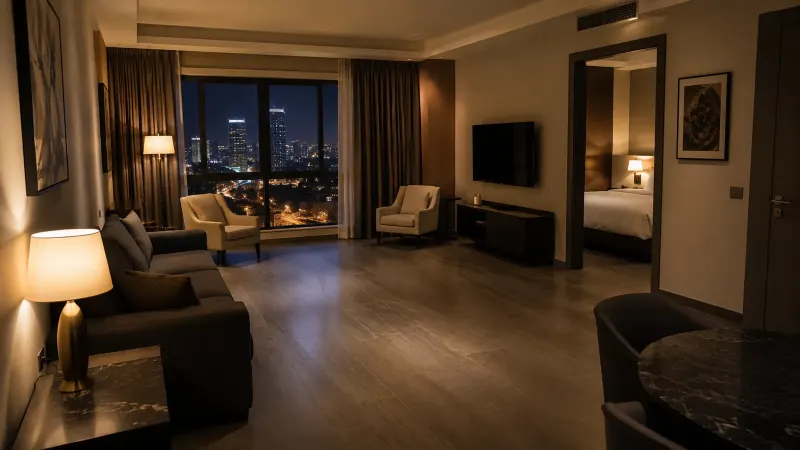
A suite is built differently, and it is where most hotel stripper bookings end up. It has a lounge separated from the bedroom, usually with a door between them. That single difference is what makes the evening possible. Apartment hotels and holiday flats share the same layout, so they belong on the shortlist too.
Four types of accommodation
The table compares the four options that actually exist in Israel, judged by what matters for this kind of evening rather than by star rating.
| Type | Room for a show | Separate room | Visitor policy | Group size |
|---|---|---|---|---|
| Standard hotel room | None | None | Usually restricted | Not suitable |
| Hotel suite | Separate lounge | Yes | Varies, ask first | 6 to 12 |
| Apartment hotel | Full living room | Yes | More flexible | 10 to 18 |
| Private holiday flat | Full living room | Depends | Set by the owner | 10 to 20 |
The bottom three rows all work. What separates them is capacity and how flexible the operator is. The first row is there only to show why a large, attractive double still is not the answer.
What the hotel actually checks
Israeli hotels are not interested in what happens inside your room. What concerns them is how many people come in, until what hour, and who covers the damage if something breaks.
Many properties publish a written visitor policy. It caps guests who are not registered to the room, sets an hour by which they leave, and sometimes asks them to sign in. None of it targets anyone. It applies to every gathering equally.
Business hotels in Tel Aviv tend to be stricter. Resort hotels in Eilat and Tiberias are looser. Apartment hotels are the most flexible, because there is no staffed lobby to cross.
The call to reception
This is the part people dread most, and it is unnecessary. Nobody is going to explain the evening's programme to the receptionist, and the question you ask is entirely neutral.
Ask how many guests the room may host, until what hour, and whether a noise policy applies. People hosting family ask the same thing dozens of times a day. The answer closes most of the open issues.
What does not work is assuming. Twelve people arriving at a hotel that permits four find out in the lobby. That is the worst possible moment.
What to confirm before booking
A short list that one phone call settles, before payment rather than after:
- How many unregistered guests may be in the room at the same time.
- Until what hour visitors are allowed to stay.
- Whether visitors must sign in, and what they need to bring for it.
- Whether a noise policy applies after a certain hour and what counts as a breach.
- Whether the room sits next to the lift or a service area, since those are noisy anyway.
- Whether there is a deposit and how long the refund takes.
Six points, one call, and they settle before a stripper is even booked. They remove the problems you cannot fix on the spot. After that, choosing the room is routine.
Noise on your floor
Hotel walls are thinner than they look. The neighbours are a metre and a half away. Ignore that and you get a knock on the door halfway through.
The fix is not to drop the music but to cut the bass. Bass travels through walls and floors. Higher frequencies stay in the room. Moderate volume with less low end sounds full inside and barely registers outside.
Ask for a high floor at the end of a corridor. Fewer adjacent rooms, less traffic past your door, less chance of a call to reception.
Where the stripper changes
A private flat always has a bedroom that locks for a few minutes. A standard hotel room does not. One more argument for a suite.
With one room only, the bathroom is the answer, provided it is dry and tidy. Buried under wet towels after eight showers, it is not.
The simple rule is to clear that space half an hour ahead rather than discovering at the last moment that everyone has left their clothes in it.
Arrival and the lift
A stripper arrives in ordinary clothes, carrying a bag, like any other guest crossing the lobby. That is a professional privacy standard, and it protects her first.
What you provide is an exact room number and a phone somebody answers. A lobby is busy. Searching three floors over a wrong number is what draws attention.
If visitors must sign in, one person goes down and handles it in two minutes. Do it openly. A hotel that catches a workaround reacts far harder than one that was simply asked a question.
Check-in, hours and a late checkout
Hotel hours are the detail most groups forget, and they shift between properties. Rooms open in the afternoon. Checkout falls in the late morning.
So an evening ending at three collides with an eleven o'clock checkout, and nobody is in a state to pack. A late checkout is arranged in advance. Many hotels grant it for a small fee, or free when occupancy is low.
Booking strippers for a late start means working backwards from check-in too. A room that opens at four leaves time to settle. A room released at six, with dinner after it, reaches the show with no margin.
Whose name the room is under
One person holds the reservation and their card stays on file as the deposit. Not a technicality: that is who the hotel calls during the night.
It should be the organiser, not the guest of honour. The organiser can go down to the lobby. The guest of honour is meant to be upstairs.
Ask about the deposit before paying. Amounts differ between chains and refunds can take several business days.
The lobby, the bar and the morning after
A hotel is more than a room. Plenty of groups start in the hotel bar and only then head upstairs. It saves travel and keeps everyone in one place.
Breakfast is the second point. It usually covers only guests registered to the room, and whoever slept on the sofa does not count. One question at reception prevents an argument at the dining room door.
There is a quieter advantage. A group that books strippers to a hotel and sleeps there needs no designated driver. Nobody drives after drinking. On its own that justifies the price gap against a flat.
Five common questions
Can the hotel refuse?
A hotel may limit visitor numbers and hours, and that applies to any gathering in a room. Checking in advance is therefore worth more than improvising on the spot, and it takes two minutes by phone.
Suite or holiday apartment?
A suite suits a group that is also sleeping at the hotel and wants service and a lift. A holiday apartment is better for a larger group that wants full flexibility on hours, with no lobby and no visitor policy.
What about the neighbours?
Take a high floor at the end of a corridor, cut the bass rather than the volume, and close the loud part of the evening before the late hours.
Can it be booked for daytime?
Yes, and in hotels daytime is often easier. Corridors are empty, visitor policies are looser, and the staff are occupied with housekeeping rather than with quiet hours.
What is and is not part of the evening?
Viewing is for ages 18 and over only. The content is a dance and entertainment performance. Intimate contact and sexual services fall outside it entirely, and no fee adds them.
What not to do in a hotel
A few things that are fine in a private flat do not travel to a hotel.
Heavy furniture stays where it is. Moving an armchair and a coffee table is fine, and in a suite that clears the centre.
Do not bring in more people than agreed. Most hotels have cameras in the lobby and corridor, and an excess head count is the first thing logged.
And skip the creative cover stories. The hotel cares about numbers and noise. Both can be answered honestly without detail.
The list to run the night before
Reduced to the few lines worth checking the evening before, it comes to this:
- A suite, apartment hotel or holiday flat. Not a standard double.
- A call to reception about visitor numbers, hours and noise. Before paying.
- A high floor at the end of a corridor, away from the lift.
- An exact room number and a live phone with the organiser.
- A bathroom or side room cleared and tidy half an hour ahead.
- Music at moderate volume with the bass turned down.
- A flexible date where possible, and ideally outside holidays and the summer months.
Formats, what a show includes and current pricing are all set out on our services page. Once the hotel is confirmed, the date and room go to the booking team. If the evening is for a work team rather than a group of friends, the separate guide to a strippers night for a work team covers what changes.
Planning an event? We can help
Send the city, date and number of guests — get a recommendation and a fixed price within minutes.