Who Organises a Strippers Night for a Work Team and Where the Line Sits

The team dinner ended at ten. The waiter cleared the table. Four people were already standing up to drive home. Nine stayed seated, and one said it seemed a shame to break it up now.
That is how almost every evening described here begins. Not with a management decision, but with a few employees who want to carry on. Anyone weighing up whether to book strippers from our roster should first understand what they are organising. It changes every other decision.
What separates a company event from a private night out?
Everything else rests on this, and it is not a matter of wording. A company event is convened, funded and expected. Attendance gets noticed even when nobody counts openly.
A private evening among colleagues is different. People who work together meet after hours, off site, at their own expense. Whoever does not come simply does not come.
Three markers separate the two without room for argument:
- Who pays. A company card versus a split between the people attending.
- Who invited. Management or HR versus a colleague who suggested it to the group.
- What happens to whoever skips it. A question the next morning versus nothing at all.
A stripper show for adults over 18 belongs strictly to the second category. Once it reads as company business, quiet pressure builds on people to attend. That is what turns a good night into a problem.
Who books it and who pays?
Whoever attends. Booking strippers for this is not a company expense and should not touch a corporate card.
It is simpler that way. A group that splits the cost settles it in one conversation, with no approvals and nobody outside the room involved.
The organiser is usually one of the group, not its senior member. He coordinates and answers the phone on the night.
Which three stripper night scenarios actually happen?
Almost every enquiry falls into one of three patterns. Each has its own logic.
| Scenario | Who stays | Typical hour | Venue | What matters most |
|---|---|---|---|---|
| Evening after work | 6 to 10 people | 21:30 | Flat or rented space | Finishing before midnight |
| Team offsite with an overnight | 8 to 16 people | 22:30 | Cabin or suite | Separation from the formal part |
| End of year night | 10 to 20 people | 22:00 | Rented private space | Who knows and who does not |
The middle row is the trickiest, because an offsite is a company event. The private continuation must be detached in time and place, not look like another item on the programme.
Who gets told in advance?
Everyone who will be in the room. No exceptions.
A surprise works when aimed at one person the group knows well. It fails with colleagues. Whoever was not told lands in a situation they did not choose, in front of people they see every morning.
One message is enough: private continuation at a flat after dinner, join if you want. The choice stays with each person.
What about someone who would rather skip it?
Nothing. He drives home.
What matters is how it looks. No show of hands, no persuading, no jokes about whoever left. Work groups remember those things far longer than friends do.
Close the shared part properly, say goodnight, then move on. Whoever stays does so freely, and whoever left is on no list.
Why not at the office?
Because an office is a workplace at ten at night too. Cameras, a cleaning crew arriving at odd hours, other floors with people unconnected to you.
There is a plainer reason. An open plan floor with desks and screens has nowhere to clear a circle and no closed side room for a stripper to change in.
And anything happening in the company's building becomes the company's business. That is what this evening is meant not to be.
What gets asked on the phone?
Can you invoice the company?
An evening of this kind is arranged as a private booking by the people attending rather than as a corporate expense. Payment is settled with the organiser, and so is all the coordination around it.
We are a mixed group of men and women, does that work?
Yes, provided everyone knows in advance and nobody is caught out. A mixed group responds well when participation is clear beforehand and watching stays a matter of choice.
How far ahead should we book?
The closer the date sits to a weekend or to the holiday season, the earlier it pays to ask. A midweek evening is usually straightforward even at short notice.
Some of us travel in from other cities, what then?
Pick a location convenient for the majority rather than for the organiser. A group arriving from 3 cities does better in a central spot than at the flat of whoever offered first.
Can it run inside the offsite itself?
Not inside the official programme. After the organised part has ended, in a separate place, it fits perfectly well.
Where exactly does the show stop?
The minimum age for watching is 18. The format stays within dance and entertainment, sexual services and intimate contact are not part of it, and the stripper sets the line during the show.
So where does it happen?
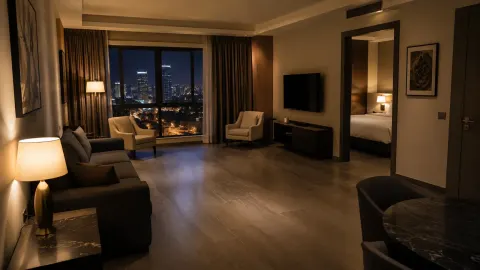
Three options cover it: a flat belonging to someone in the group, a space rented for the night, or a hotel room.
A flat is cheapest and fastest, but leaves one person with the cleaning and the neighbours. A rented space solves both and suits larger groups. A hotel works when the group sleeps there too, and the details sit in strippers in a hotel.
Most of these evenings happen around Tel Aviv and the business districts near it, with Ramat Gan, Petah Tikva and Rishon LeZion taking a large share. In the north it is Haifa, mainly around the bay.
What about managers and their reports?
This is the most sensitive point here, and it deserves saying plainly. When a manager organises and invites his own reports, attendance stops being free.
People say yes to a manager for reasons unrelated to wanting to. Some turn up so as not to stand out. Some sit uncomfortable all evening and say nothing.
The fix is simple. Let the organiser be a peer, not a superior. A manager is welcome to join as a participant like anyone else, and the difference is felt in the room.
How does it fit into an offsite?
An offsite is built in stages and each stage has an owner. The activity, the meal and the formal items belong to the company. The hours after do not.
The boundary is a clear close to the official part. Somebody thanks everyone and says the organised portion is over. What follows belongs to whoever stayed.
That also means a different location. Not the same dining room or hall, but a suite or cabin one of the participants took on.
When in the year does this come up?
Three moments recur. Year end, when teams close targets and go out together.
Then the end of a project. After months of pressure a team draws a line, on a random date mid year.
The third gets discussed less: the night after a conference. Everyone is already in the same hotel, the formal days are over, and some stay an extra night. Booking strippers for that happens at the last minute, so check availability before the conference starts.
What changes when half the team is remote?
In hybrid teams this carries different weight. People who meet monthly share less history.
The opening stretch has to run longer. A daily team settles in within 15 minutes. A remote team needs a whole meal first.
There is a flip side. People know each other's limits less well, so the advance message matters twice as much.
How is the money collected?
Not at the end of the night. That is the common mistake, and it ends in a conversation about who owes what.
Settle the amount before the date. The organiser says what it comes to per head, collects by transfer, and closes it days ahead.
Leave a margin. A group that collected exactly to the calculation gets stuck when someone joins late.
How many people is the right size?
For an evening with strippers the comfortable range is 6 to 15. Below 6 it gets tight. Every reaction is audible and there is no crowd to sit inside.
Above 15 the room splits and part of it misses out. In work groups that happens earlier, because people gravitate to whoever they sit near at the office.
Format against group size, and what a show includes, are both covered on our services page.
What if something gets out of hand?
The awkward situations repeat themselves, and each is solved by one response on the spot.
| What happens | Why it is a problem | What to do |
|---|---|---|
| Someone brings a partner | An outsider changes the dynamic of a work group | Agree in advance that it is team only |
| Someone starts filming | Footage of colleagues like this lasts forever | Ask for phones in pockets before the start |
| A colleague who was not told walks in | He lands in a situation he did not choose | Pause and let him decide |
| Somebody drank too much | One guest ruins it for everyone else | Seat him away from the circle with company |
| The group splits across two rooms | Half the show is lost | Bring everyone into one room first |
Those five cover what actually occurs. The rest almost never happens.
What should you not do?
A short list of things that look harmless and break a work group's evening:
- Do not post it in the company wide chat group.
- Do not mention it in a work email or a shared calendar.
- Do not film and do not put anything online.
- Do not bring in anyone who was not told beforehand.
- Do not turn it into an annual tradition people feel obliged to attend.
- Do not discuss it at the office the next day in front of anyone who was not there.
The last item matters most and is forgotten most often.
What is left of it the next morning?
For a group that handled it well, almost nothing. An inside joke among those who were there, and that is all.
For a group that handled it badly, something else remains. An employee who did not want to be there. A clip doing the rounds. Somebody's sense that they alone said no. Those stay in a team long after the evening is forgotten.
The gap between them is not budget or venue. It sits in 3 messages sent beforehand, and in nobody being pushed into anything.
With those settled, the rest is logistics. The date and the place go through the contact form.
Planning an event? We can help
Send the city, date and number of guests — get a recommendation and a fixed price within minutes.